

JUPITER
There is no single person who is credited with the discovery of Jupiter. Jupiter is one of the five planets that can be seen in the night sky without using a telescope or binoculars. The planet Jupiter has been known since ancient times and has been observed for thousands of years by people from many different cultures.
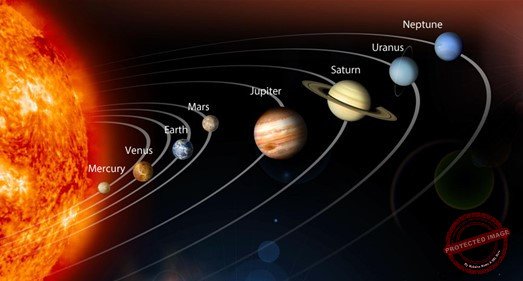
THE LARGEST PLANET JUPITER
The largest planet in our solar system by far is Jupiter, which beats out all the other planets in both mass and volume. Jupiter’s mass is more than 300 times that of Earth, and its diameter, at 140,000 km, is about 11 times Earth’s diameter. Jupiter is 2½ times more massive than the rest of the planets in the solar system combined
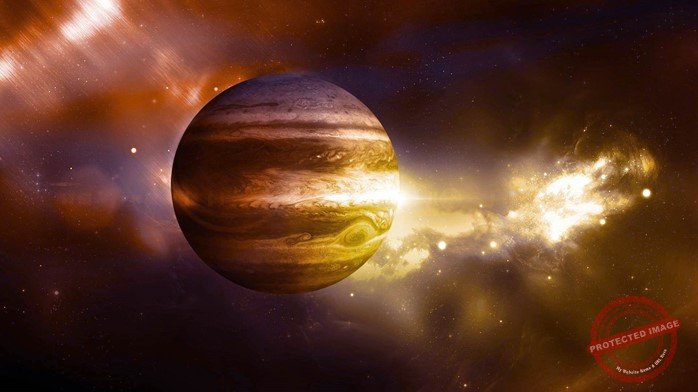
JUPITER SURFACE
Jupiter does not have a solid surface like terrestrial planets such as Earth. Instead, it transitions gradually from gas to liquid as you move deeper into its atmosphere. The boundary between Jupiter’s gaseous atmosphere and its liquid interior is not well-defined, making it challenging to pinpoint where the “surface” begins.
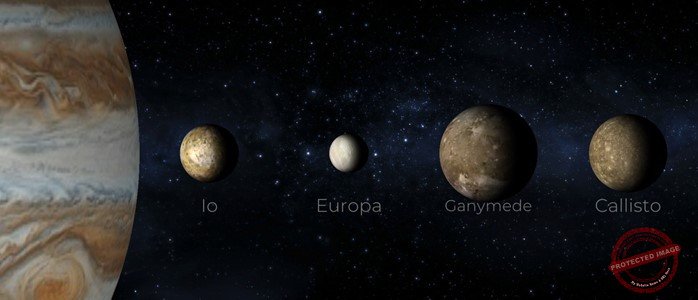
JUPITER’S MOONS
The four largest moons are called Io, Europa, Ganymede, and Callisto. These four moons are called the Galilean satellites because they were first seen in 1610 by the astronomer Galileo Galilei. Ganymede is the largest moon in the Solar System, with a diameter of 3,260 miles. Io has a lot of active volcanoes and is covered with sulfur. Callisto may have a water ocean beneath its heavily cratered icy, rocky surface. Europa, which is covered by a cracked, icy surface, may also have a liquid water ocean. The other moons are smaller and have irregular shapes. Most of these small moons are believed to be asteroids that were captured by Jupiter’s strong gravitational pull.
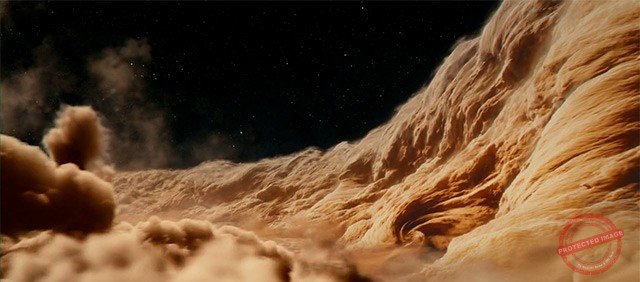
JUPITER’S ATMOSPHERE
Jupiter is made up predominantly of hydrogen. The simple, basic gas, a prime ingredient on the sun, accounts for 90 percent of the atmosphere. Nearly 10 percent is composed of helium. A very small fraction of the atmosphere is made up of compounds such as ammonia, sulfur, methane, and water vapor.
LAYERS OF THE ATMOSPHERE
The layer resting on the “surface” of Jupiter is known as the troposphere, and extends to approximately 31 miles (50 kilometers) above the surface. The troposphere contains ammonia, ammonium hydrosulfide, and water, which form the distinctive red and white bands seen from Earth.
The next layer, the stratosphere, extends to almost 200 miles (320 km) above the surface, containing hazes of hydrocarbons. Here, temperatures start at minus 260°F and rise to approximately minus 150°F (minus 100°C) the higher you go. The stratosphere, like the troposphere, is warmed by the sun and the planet’s interior. The stratosphere ends where the pressure is one thousandth of that found at the Earth’s surface.
The thermosphere lies above the stratosphere. Temperatures rise to approximately 1,340°F (725 °C) at heights of over 600 miles (1,000 km). The aurora around the poles occurs within the thermosphere.
RED SPOT ON JUPITER
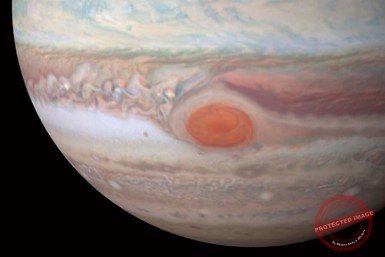
The Great Red Spot is a giant, spinning storm in Jupiter’s atmosphere. It is like a hurricane on Earth, but it is much larger. Jupiter’s Great Red Spot is more than twice the size of Earth! Winds inside this storm reach speeds of about 270 miles per hour. Nobody knows when the Great Red Spot first appeared on Jupiter, but it has been seen on Jupiter ever since people started looking through telescopes about 400 years ago.
THE STRIPES OF COLOR ON JUPITER
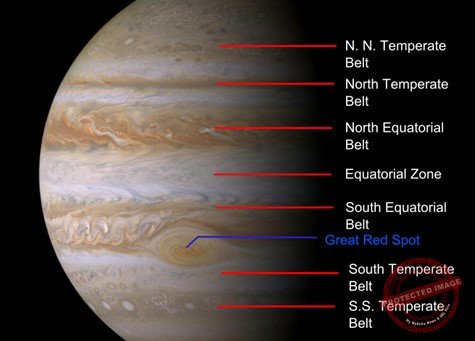
The stripes of color on Jupiter are called its bands. There are two types of bands on Jupiter. The light colored bands are called zones. These are regions where gas in Jupiter’s atmosphere is rising upwards. The dark bands are called belts. These are regions where the gas in Jupiter’s atmosphere is sinking downwards. The colors in the bands are caused by slight differences in their temperatures and their composition (what chemicals are in them). Bands that are next to each other have winds which move in opposite directions.
A DAY ON JUPITER
A day on Jupiter is significantly shorter than a day on Earth. Jupiter rotates much faster, completing one rotation in about 9 hours, 55 minutes, and 30 seconds, which means a single day is just over a third the length of an Earth day. This means Jupiter has the shortest day of all the planets in our solar system.
JUPITER’S YEAR COMPARED TO EARTH’S YEAR
Jupiter revolves or orbits around the Sun once every 11.86 Earth years, or once every 4,330.6 Earth days. Jupiter travels at an average speed of 29,236 miles per hour or 47,051 kilometers per hour in its orbit around the Sun.
JUPITER’S EXISTANCE OF ANY LIFE
Jupiter is considered inhospitable to life as we know it. Its extreme radiation levels, lack of a solid surface, and harsh atmospheric conditions make it unlikely to support life as we understand it. However, some of Jupiter’s moons, such as Europa and Ganymede, are considered potential candidates for hosting subsurface oceans that could potentially harbor microbial life.